



When a sidewall repair fails, most people assume the adhesive didn’t hold.
If something lifts or peels, the glue is the first thing to blame.
But after years of calls, messages, and trail stories here at GlueTread, we’ve seen a pattern. Most of the time, the tire repair adhesive isn’t the problem. The outcome usually comes back to tire prep.
Why Tire Prep Matters in Emergency Tire Repair
Emergency tire repair rarely happens in a calm, easy setting. It’s getting dark. The weather’s turning. The group wants to move.
In those moments, sanding feels like the slowest and least important step.
Still, tire prep is one of the most important parts of the entire repair.
Tire sidewalls flex constantly. They get dirty. They pick up mud, dust, and debris. Many also have raised lettering or uneven areas where the damage has torn into the rubber.
If you try to lay a patch over raised lettering or an uneven tear, it won’t sit flat. And if the patch doesn’t sit flat, it won’t seal evenly.
Good tire prep is about creating a flat surface so the patch can lay flush against the sidewall.
That’s it.
What Proper Tire Prep Actually Means
There’s a common misunderstanding that tire prep is about aggressively grinding down the tire so the adhesive can “grab.”
That’s not the goal.
The goal is to remove raised lettering, smooth out rough damage, and create a flat, even surface for the patch to bond to. If the damage is already in a smooth area of the sidewall, very little sanding may be needed.
When the surface is prepped correctly, the patch lays flat and bonds evenly across the repair area.
That difference shows up quickly in emergency tire repair situations.
One Amazon reviewer put it plainly:
“This actually worked even though I was skeptical at first. Key is following the directions (not adding too much adhesive) and cleaning the application surface very well before applying the patch. Would recommend.”
Not more adhesive.
Better tire prep.
Another customer, Brian Collins, shared on GlueTread’s Facebook after redoing his repair:
“After a phone call to discuss, I reapplied a new patch, adjusting the surface prep technique a bit, and the new one is holding up great! Thanks GlueTread for the awesome customer service.”
The adhesive didn’t change. The tire prep did.
Why We Built a Tire Prep Kit
We realized that many sidewall repair failures weren’t product failures. They were rushed steps, usually because someone didn’t have the right tools or didn’t want to spend extra time sanding.
That’s what led to the GlueTread Tire Prep Kit.

The Prep Kit wasn’t built to add more steps. It was built to make proper tire prep easier. The marker helps outline the repair area. The razor knife helps trim cleanly. The sanding flap wheel, used with a standard drill, helps level raised areas quickly and evenly.
The flap wheel requires a regular drill. It will not work with an impact driver.

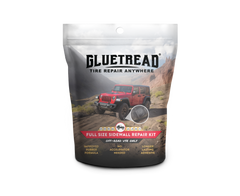
We also offer the Prep Kit bundled with several of our core repair systems, including SXS, full-size, and expedition kits. No matter which kit you carry, proper tire prep helps every patch perform better in emergency tire repair situations.
Slowing Down Makes a Difference
GlueTread’s tire repair adhesive is built to handle heat, cold, and pressure in real off-road conditions.
But how well that adhesive performs still depends on tire prep.
If a repair doesn’t hold, it’s worth asking whether the surface was truly flat and ready before assuming the adhesive failed.
We get it. Tension is high. Everyone’s staring at the flat tire. The goal is to get moving again as fast as possible.
But taking a few extra minutes to level the surface, clean the area, and follow the directions often makes the difference.
Adhesive matters.
Tire prep matters more.
Leave a comment