




Some people carry a spare and hope they never need it. Others assume tire failure is part of the deal and plan accordingly. If you fall into the second camp, a flat tire repair kit is usually the first thing you reach for.
That’s where a tire fix kit comes in, not as a cure-all, but as a practical way to deal with the kinds of tire problems you expect to happen. This guide breaks down what actually matters in a flat tire repair kit, what often gets overlooked, and how to choose one that fits the way you use your equipment.
Why “Tire Fix Kit” Is Often the First Thing People Search For
After dealing with a few flats, most people stop looking for perfect solutions and start looking for practical ones. Replacing tires gets expensive, downtime adds up, and not every failure feels worth a full replacement. That’s when people start searching for a “tire fix kit.” Experience has taught them the problem will come back around.
The problem is that many tools marketed as a tire fix kit are built around a single type of failure, usually a straightforward tread puncture. That works when the damage is obvious and limited, but real-world tire problems are often less clean. Slow leaks, sidewall damage, or air loss from places other than the tread can turn a quick fix into wasted time if the kit isn’t built for more than one scenario.
GlueTread’s flat tire repair kits are meant to bridge that gap. We didn’t set out to make the fastest or cheapest fix on the market. What mattered more was giving customers the right tools to deal with problems that aren’t immediately clear. For people who expect tire issues as part of using their equipment, that distinction makes all the difference.
What a Flat Tire Repair Kit Actually Needs to Handle
A flat tire repair kit is only useful if it can handle more than the simplest failures.
Many people start with what they think of as a tire fix kit, then realize they need something more capable after dealing with a few real-world tire failures.
Tread punctures.
This is the most familiar type of damage and the one many kits are built around. Nails, screws, and sharp debris can usually be handled quickly when the puncture is clean and confined to the tread.
Sidewall damage.
Sidewalls take abuse from rocks, roots, curbs, and uneven terrain. Damage here is less predictable and often rules out simple plug-only fixes. A flat tire repair kit should be prepared for this possibility, not just ideal conditions.
Air loss that isn’t a puncture.
Not every flat comes from something piercing the tire. Valve stems, bead leaks, and slow pressure loss can be just as disruptive, especially when the source isn’t immediately obvious.
Getting the tire back to usable pressure.
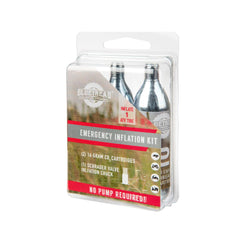
Repairing damage is only part of the equation. A kit needs to support reinflation so the tire can be put back into service long enough to finish the job, get off the trail, or reach a place where a permanent repair makes sense.
A flat tire repair kit doesn’t need to solve every problem forever, but it does need to cover the failures you’re most likely to face. That’s the difference between carrying tools and carrying peace of mind.
When a Flat Tire Repair Kit Makes More Sense Than a Spare
A spare tire still has its place, but it isn’t always the most practical option. In many real-world situations, a flat tire repair kit is faster, easier, and more realistic than swapping a wheel.
A repair kit often makes more sense when:
- You’re working or traveling far from help, where changing a tire is time-consuming and physically demanding
- Downtime matters more than perfection, and getting moving again is the priority.
- The equipment is heavy or awkward to service, making tire changes difficult.
- More than one tire could be at risk, where a spare only solves part of the problem.
There are still times when a spare is the right call. Long highway travel, high-speed use, or severe damage may require a full replacement. The goal isn’t to eliminate spares altogether, but to recognize when a flat tire repair kit is the more practical tool for the situation.
Which GlueTread Kits Cover These Scenarios
Not every flat tire repair kit is built for the same type of use, which is why GlueTread offers several options. Choosing the right kit comes down to the kind of equipment you use and the tire problems you’re most likely to encounter.
For off-road vehicles, side-by-sides, and trail rigs, the GlueTread SxS Kit and SxS Pro Kit are designed to handle more than basic tread punctures. They’re built with sidewall repairs in mind and include the tools needed to address damage that isn’t always obvious at first glance.
For farm, utility, and work equipment, the GlueTread Tractor Kit is better suited to heavier tires and repeated use. It’s designed for situations where changing a tire isn’t realistic and getting equipment back into service matters more than a cosmetic fix.
For general preparedness across multiple vehicles, the GlueTread Expedition Kit offers broader coverage in a single package. It’s often the right choice for people who want one flat tire repair kit that can handle a range of scenarios without guessing which problem they’ll face next.
Each kit is built around the same idea: being ready for the kinds of tire failures that actually happen, not just the easiest ones to fix.
Tire failure isn’t unusual. Being ready for it is what makes the difference.
Leave a comment