


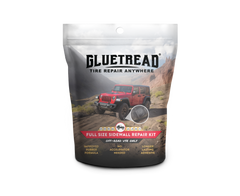

Photo credit: GlueTread customer, Chris Cordell.
When people think about tire repairs, adhesive is often treated as an afterthought. It is easy to assume it functions like basic glue: apply it to the patch, apply the patch, and move on. In controlled shop conditions, that assumption might hold. In real-world off-road environments, it does not.
That is why GlueTread tested its tire repair adhesive extensively in the early stages, working through heat, cold, and pressure to dial in a formula that could handle real-world conditions. These factors are not theoretical concerns. They are the forces that determine whether a repair holds or fails.
While the formula itself has remained consistent, real-world use continues to validate those early tests. Customer stories and trail reports regularly reflect the same performance seen during development, reinforcing why the adhesive works the way it does. Understanding how tire repair adhesive performs under heat, cold, and pressure helps explain why some repairs last and others do not.
How Heat Affects Tire Repair Adhesive
Tires naturally generate heat as they roll. Friction with the ground, internal flexing, and ambient temperatures all contribute, especially during long drives or low-pressure off-road use.
When exposed to heat, low-quality adhesive can soften, lose bond strength, or begin to separate from the tire surface. This is especially problematic during tire sidewall repair, where constant flexing compounds the stress on the bond.
GlueTread’s tire repair adhesive is engineered to perform across a wide temperature range, from approximately 0°F to 100°F. Rather than melting or breaking down within that range, it maintains flexibility and bond strength so the repair can move with the tire instead of fighting against it.
“…I used [a GlueTread kit] that I borrowed from someone on the trail. I followed the directions and it got us back to our truck. Over 90 miles in the Arizona desert with no cell service. Immediately came home and bought a pack. Your best option for a sidewall repair in a pinch.”
– Ryan J.
How Cold Impacts Adhesive Performance
Cold temperatures introduce a different challenge. Many adhesives become stiff or brittle in freezing conditions, making it difficult to form a reliable bond. Repairs that seem solid initially can fail once the tire flexes or temperatures fluctuate.
For off-road use, adhesive must remain workable in cold weather while still curing properly. During tire sidewall repair, flexibility matters just as much as strength. An adhesive that cracks or hardens too quickly will not tolerate repeated flexing in cold conditions.
“I don’t think there’s any better product testing than the Alaska extremes [for GlueTread], not to mention how cold that air is at altitude!”
– Ged O.
Why Pressure Is the Ultimate Test
Tire pressure applies constant stress to any repair. Every rotation creates outward force, and sidewalls experience the most movement. Unlike tread repairs, sidewall repairs must tolerate expansion, compression, and repeated flex.
If adhesive only seals the surface without bonding deeply to the rubber, pressure will eventually find a weak point. This is why tire sidewall repair requires an adhesive that bonds evenly and flexes with the tire rather than resisting its natural movement.
“I have used [GlueTread patches] on two different UTV tires in the past year. 1-inch rock cuts. Still running both tires. One even has rock rubs all over it!”
– Brian C.
Why Adhesive Performance Matters in the Field
Field repairs rarely happen under ideal conditions. Terrain is uneven. Temperatures fluctuate. Time is limited. In those moments, adhesive performance becomes the deciding factor between continuing the trip or cutting it short.
The combination of engineering testing, chemical formulation, and real-world customer feedback explains why some tire repair adhesives consistently perform better than others. When a repair holds through heat, cold, and pressure, it is rarely by accident. It is the result of design, testing, and experience applied where it matters most.
Leave a comment